on protocols & organizing
This is what I have been thinking about when I think of 'p4p': not just a version bump for a technology with a specific network shape; but a way of working in solidarity towards a common goal — even when we are working on different projects.
from @gwil (of wormblossom) on ssb: %ydpYgAf1+8iBAMSiFAbPG32ltwdVQQSJb0G7tjRGgvM=.sha256

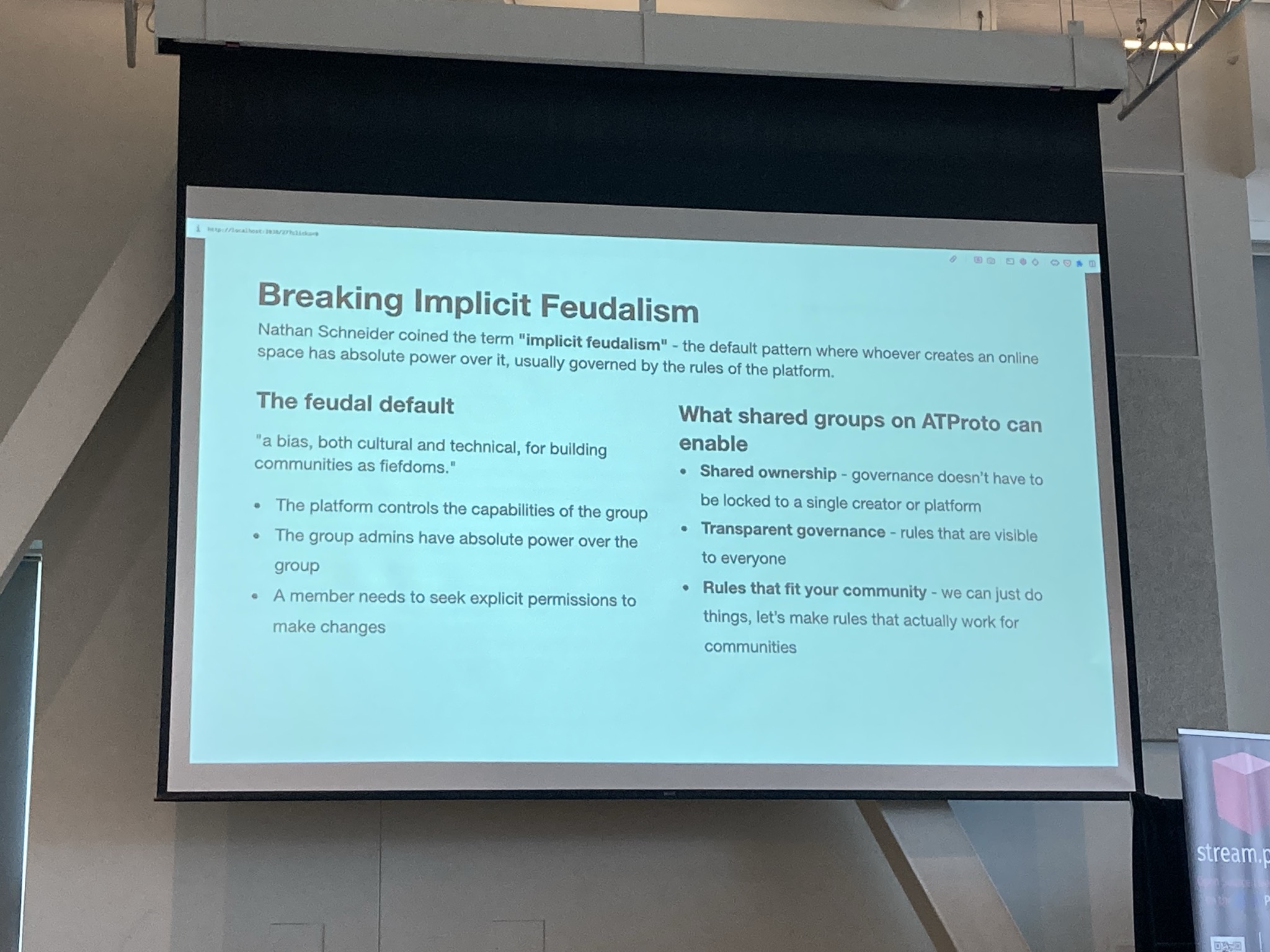
atproto conference is both technical, and a form of movement building
"Community is the only moat" — Rudy Fraser of Blacksky (link)
especially with the rise of AI and malleable software (see attie.ai and malleable systems collective), is a software artifact sufficient to build a business around?
POSIWID
The purpose of something is what it does.
What ActivityPub has produced, in practice, is a network of independently operated servers whose coordination depends on bilateral trust relationships between their administrators. The practical consequence is that your server’s administrator is the single most important governance actor in your social media experience, more important than any protocol feature or network-level norm.
Matrix’s operational reality comes closest to its stated purpose. The protocol does what it says it does: it enables end-to-end encrypted, federated communication with no single point of control ... But Matrix also shows where protocol-level governance runs out. Room-level power levels provide a mechanism for governance, not a framework. The hard problems of community governance, including how to handle persistent bad actors who move between rooms, how to balance open federation with safety, and how to fund infrastructure sustainably, are not solved by the protocol’s mechanisms but deferred to the communities that use it.
The Purpose Of Protocols — Laurens Hof